Toyota Ipsum User Guide
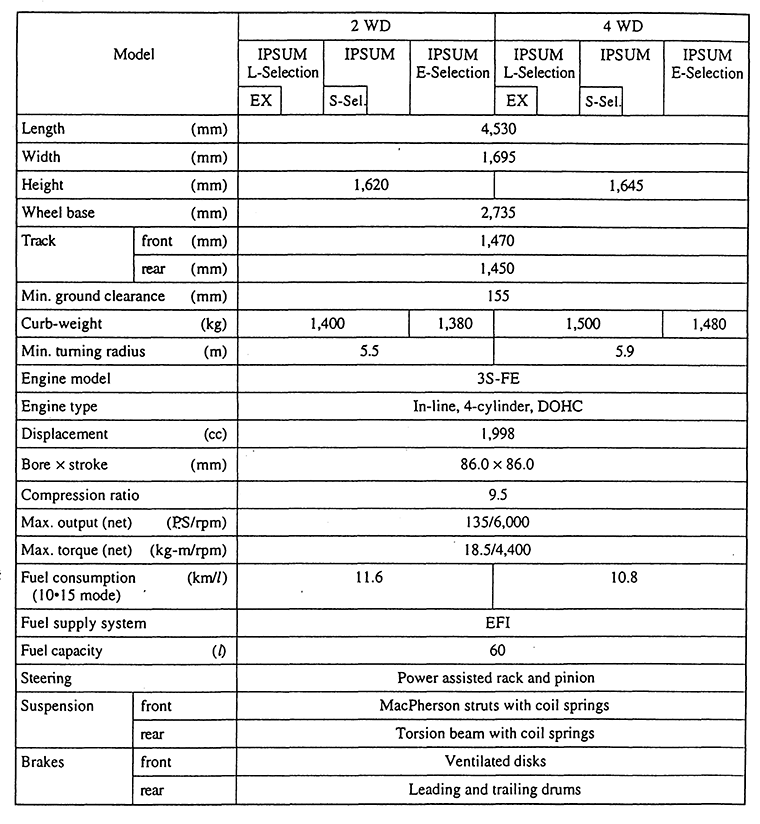
If looking for a ebook Toyota ipsum 2017 owner manual in pdf format, then you have come on to correct site. We presented the full edition of this book in txt, ePub. The new IPSUM employs Toyota's powerful 2.0 liter, in-line, 4-cylinder power plant which produces maximum power at 135ps/6000rpm and 18.5kg-m of torque at 4400rpm. Delivering strong bottom-end torque in the low to midranges, the 3S-FE engine generates highly responsive acceleration across the entire power band.
We are proud to announce a significant enhancement to our Hybrid Battery Warranty. Starting with the 2020 model year, every Toyota hybrid battery warranty is being increased from 8 years or 100,000 miles, to 10 years from date of first use, or 150,000 miles whichever comes first. This enhancement serves as an indication of our confidence in the quality, dependability, and reliability of our products.
On top of our basic coverage, we offer:
Hybrid-Related Component Coverage1 Hybrid-related components, including the HV battery, battery control module, hybrid control module and inverter with converter, are covered for 8 years/100,000 miles. The HV battery may have longer coverage under emissions warranty. Refer to applicable Warranty & Maintenance Guide for details.
Powertrain Coverage1 60 months/60,000 miles (engine, transmission/transaxle, front-wheel-drive system, rear-wheel drive, seatbelts and airbags).
Rust-Through Coverage1 60 months/unlimited miles (corrosion perforation of sheet metal).
Emissions Coverage1 Coverages vary under Federal and California regulations. Refer to applicable Warranty & Maintenance Guide for details.
For Toyota hybrid vehicles beginning with model year 2020, the hybrid (HV) battery is covered for 10 years from original date of first use or 150,000 miles, whichever comes first. Coverage is subject to the terms and conditions of your New Vehicle Limited Warranty. See Owner's Warranty and Maintenance Guide for details.
Toyota is well-known for producing high-quality vehicles, and both the Toyota Ipsum and Toyota Wish are no exception. While both of these popular minivans offer unique advantages, they each have a variety of similarities. In this used Toyota Ipsum vs. Toyota Wish car comparison, we take a closer look at similar model years to help you understand what makes each used Toyota minivan stand out.
Toyota Ipsum vs Wish Quick Comparison
Before we get into the details of what separates the Toyota Ipsum from the Wish, here is a quick overview of the details we will be looking at later.
| Toyota Ipsum | Toyota Wish | |
|---|---|---|
| Fuel Consumption | 11km/L – 12km/L | 13km/L – 14km/L |
| Key Features | Power Seating Xeon Headlights Roof Rails | Suede Seats Leather Steering Verticle Headlights |
| Capacity | 6 Passengers | 6-7 Passengers |
| BE FORWARD Price (Click Prices to Shop) | $1,000 - $2,400 | $1,000 - $3,500 |
Features and Review
Toyota Ipsum
The popular 2nd generation (2001-2009) of the Toyota Ipsum, also known as the Avensis Verso, first began production in May 2001, and featured advancements over the previous generation including an increased size as best seen by the expanded trunk and interior space of the cabin. The engine was also displaced to cater to the increased space without affecting the car’s efficiency.
Recommended Toyota Ipsum Models
– Toyota Ipsum 2001
– Toyota Ipsum 2003
– Toyota Ipsum 2005
Toyota Wish
Both the 1st generation and 2nd generation of the Toyota Wish have proved popular as used minivans, with the 1st generation (2003-2009) introduced during the Tokyo Motor Show in October 2002. The initial model was almost perfect but ended up going a few modifications to enhance its overall aesthetic. In particular, adjustments were made to the headlights, bumpers, dashboard, and LED tail-lights. The switch-gear was also modified to enhance the automatic transmission and climate control. Despite these minor changes, the model retained its reputation for having a solid fuel consumption rating compared to that of other compact minivans within the market.
Recommended Toyota Wish Models
– Toyota Wish 2005
– Toyota Wish 2006
– Toyota Wish 2010
Interior and Exterior Comparison
Toyota Ipsum
The Toyota Ipsum is fitted with 7 seats arranged into 3 rows. The front cabin is wide and roomy, giving both the driver and front passenger a large amount of space. The front seats are also electric, making them easy to adjust, and the driver’s seat is set at a height that lets you clearly see the road from all sides.
The adjustable steering wheel fits the needs of any driver, while in the passenger area the seats are modified to allow for more boot space at the rear of the car, which comes in at around 1,499mm. The exterior of the Toyota Ipsum is characterized by its bright xenon headlights, roof rails, and added fog lights for safer driving in conditions where visibility is poor.
Specs
– Seating: 6
– Doors: 5
– Weight: 1,500kg
– Features: Roomy / Electric front seats / Adjustable steering wheel / Xenon headlights / Roof rails / Fog lights
Toyota Wish
The Toyota Wish was initially launched as a 6 seater, but some later models are 7 seaters. The seats are made of a suede material that is easy to clean, and the vehicle also features control panel windows and ebony wood-like elements featured in the front interior. The steering wheel is also fitted with genuine leather, giving it both a touch of elegance and a firmer grip.
The car has a sporty look thanks to its capsular design, with the rear boot at around 1,460mm. The Toyota Wish is fitted with four vertical headlamps, in addition to high-quality alloy wheels and a well-designed bumper that enhances the vehicle’s overall appeal.
Specs
Seating: 6 to 7
Doors: 5
Weight: 1,340kg
Features: Suede seating / Wood paneling / Genuine leather steering wheel / Vertical headlights / Alloy wheels
Engine and Fuel Efficiency
Toyota Ipsum
The engine of a Toyota Ipsum has a displacement capacity of 2,362cc, while the fuel tank can hold 60 liters. The engine also has 4 cylinders, each with four valves per piston. Its average fuel consumption ranges between 11km/L and 12km/L, which is mostly dependent on whether the vehicle is front-wheel drive or 4-wheel drive, giving it a combined fuel efficiency of around 11.5 km/L.
What is the Fuel Consumption? 11 to 12km/L on average
Engine: 4-cylinder
Fuel Tank Capacity: 60L
Fuel Type: Petrol
Toyota Wish
The Toyota Wish has an internal combustion system, with a maximum displacement between 1,794cc and 1,998cc and a fuel tank capacity similar to that of the Ipsum, at 60 liters. The engine has four cylinders, each with four valves. The fuel consumption ranges between 13km/L and 14km/L, which is dependent on the type of drive, and it gives a combined fuel efficiency of 13.5 km/L.
What is the Fuel Consumption? 13 to 14km/L on average
Engine: 4-cylinder
Fuel Tank Capacity: 60L
Fuel Type: Petrol
Takeoff tools that provide shortcuts for measurements, making it quicker to produce a takeoff. Cloud-based. Prebuilt reports to provide insights to inform your estimates. Download aluminum storefront estimating programs.
Which is Better, Ipsum or Wish?
The Toyota Ipsum and Toyota Wish both offer a variety of similar features, but depending on what you need in a used minivan, each car could fit different functions and desired features. For instance, the Toyota Ipsum’s boot is larger compared to that of the Wish, meaning that larger families who like to travel may be better off opting for the Ipsum.
For those who value the exterior styling of their car, the Toyota Wish could be the better option thanks to its sporty trim. In addition, the Toyota Wish offers a more powerful engine and slightly better fuel efficiency compared to the Ipsum.
Wps pdf to word converter. And this is where Microsoft Word can really come in handy. A great way to make changes to PDFs is to turn PDF into Word document, make any edits, and convert it back to a PDF.What’s the easiest way to convert PDF to Word on Mac? Copy and paste could come to mind, but it’s a hassle.
In regards to price, budget-conscious buyers may find the Toyota Ipsum their go-to, as the price point for a used Ipsum is usually offered lower than that of the Wish.
Looking for more minivan comparisons? Be sure to also check out our Toyota Noah vs. Nissan Serena and Toyota Voxy vs. Toyota Noaharticles for more insight on the best used minivans you can buy right now.